
Going from idea to execution is complicated. You want to optimize your chances of success before committing to costly product development. The best, most cost-efficient way to do so, is by means of a Design Sprint.
“Bas facilitated a recent strategy sprint activity with us for Telstra Platinum. He brings a scientific and diligently prepared approach to the design sprint, something that is often difficult to do with team members that aren’t used to the methodology. He is also excellent at navigating through challenges and fully focussing a team that is not used to separating from their day jobs to tackle a problem and design a solution together. I’d highly recommend Bas as a facilitator if you have a particularly challenging problem to tackle and you want to get results and alignment fast.”
Cameron Jackson – Head of Product Development ~ Telstra
How does it work?
A team of qualified individuals within your company gather for a week-long (full-time) sprint with an experienced facilitator (typically someone from outside the company, with a fresh perspective)
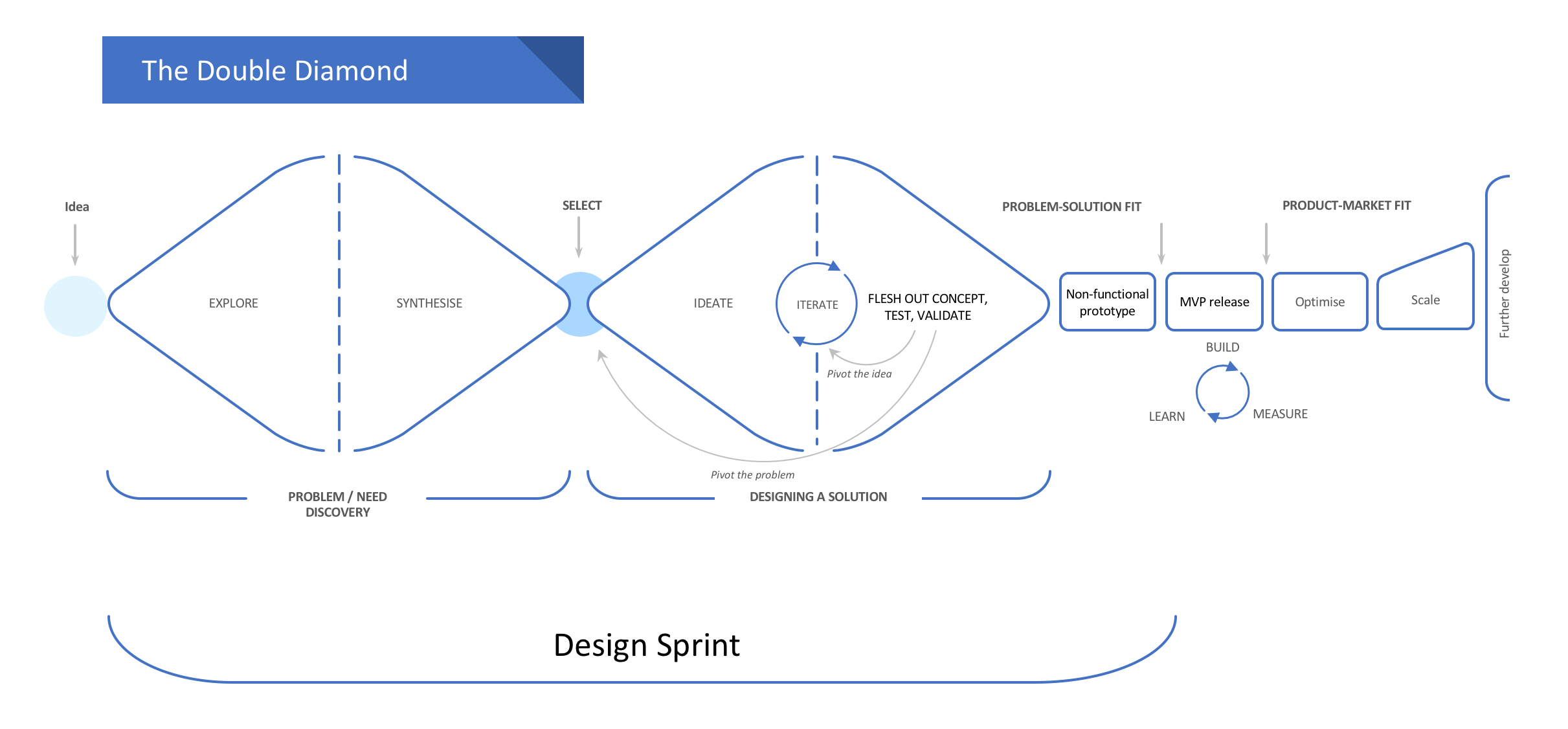
An experienced facilitator comes well prepared to the sprint, with a structure and set-up ideally suited for your business, team and project. Various concepts and tools are typically combined to suit the needs of the project team. Most tools are derived from Design Thinking and Lean methodologies. Experienced facilitators typically draw upon a wide variety of other tools, borrowed from processes for innovation in other successful companies. A simplified model of divergent and convergent thinking can be applied to most projects, resembling something like the picture below.
What makes a great facilitator?
The skill of a facilitator has a major influence on the outcome of the project. Like any other skill, it is defined by a combination of practice and talent.
A skilled facilitator has the following attributes:
Good Communicator

A facilitator needs to be able to convey what task a group should execute and more important, how they should execute. Doing so in a way which leaves little room for interpretation in a time-efficient manner is crucial to the Design Sprint.
One step ahead

In order to lead a group to a great outcome, you need to be one step ahead of everyone in the project group. It is important to draw a difference between Intellect, knowledge and skill. Ideally, the project group has much more knowledge of the idea and various subjects of the Design Sprint and a variety of skills not possessed by the facilitator. A good (humble) facilitator draws out the best in everyone, and lifts a project team to its highest potential by connecting knowledge, skills, concepts and ideas in a meaningful way, by applying them in a structure for productive innovation.
Knowledge of a large variety of subjects

A facilitator is not a subject-matter expert (SME), but they should be able to draw connections between different industries, technologies, trends and ideas. A great facilitator deeply understands the latest developments in areas from Finance to Internet of Things, Artificial Intelligence, Marketing, Law, Politics, Cognitive Neuroscience and more. In short, they need to be on top of everything, to ensure important connections and alternative solutions are understood and taken into consideration by the project team.
Not the center of attention

Watch out for facilitators who do nothing rather than hear themselves talk. (too) many words are a sign of incompetence. A great facilitator interferes only when needed, and relies on the structure they implement for the Design Sprint as well as the project team.
Adaptive

Situations inevitably change, people get sick, urgent meetings suddenly come up, customer interviews fall through, new findings come up. Fact is, you cannot plan for everything that can go wrong. A good facilitator is able to be flexible but firm. Understand when things are out of anyone’s control, but be firm when people simply do not seem to have their priorities straight.
Emotional Intelligence (EQ)

Read the room. Are people low on energy? Frustrated? Annoyed? Overly excited? A good facilitator understands how to mediate the mood of the project team. When to boost morale and how to hold the brakes when needed.
Structured, focussed & objective
The project team has to be able to think freely and trust the process. Therefore, if the facilitator loses track, the trust in the entire sprint is at risk. The facilitator should be structured at all times, with the clear goal of the sprint in mind. It is essential for the facilitator to stay as objective as possible. ‘choosing sides’ can interfere with group dynamics in a way that undermines trust and progress. Instead, a good facilitator has build-in voting mechanisms in the Design Sprint structure to ensure the objective nature of the role.

 Bas van den Bergh